
DESPATCH #007
THE UNION CIVIL SERVICES: THE PERMANENT MIND OF THE REPUBLIC
A Constitutional Meditation on the Bureaucratic Spine of the Union
by Aamir Khan Wali
Abstract
This second part of the essay examines the Indian administrative state not in its constitutional idealism, but in its operational reality. Moving beyond the philosophical foundations of the Union civil services explored in Part I, the article analyses the pressures that shape bureaucratic behaviour within contemporary governance: political centralisation, transfer culture, administrative caution, executive concentration, constitutional crisis, and the expanding architecture of the modern security and data state.
Through institutional analysis, historical reflection, and personal observations drawn from the governing ecosystem of Lutyens’ Delhi, the essay explores how civil servants navigate the uneasy terrain between political obedience and constitutional fidelity. It further reflects upon the social culture of elite administration, the reproduction of bureaucratic temperament within the Republic, and the quiet psychological burdens carried by those entrusted with sustaining state continuity beyond electoral cycles.
Ultimately, the article argues that the endurance of the Indian Republic depends not only upon democratic legitimacy, but upon the moral restraint, institutional memory, and disciplined anonymity of the administrative machinery operating beneath political spectacle.
PART II
POWER, NEUTRALITY, AND THE ADMINISTRATIVE CONDITION
I. THE MYTH OF BUREAUCRATIC NEUTRALITY
Every constitutional system publicly celebrates bureaucratic neutrality.
Yet no serious student of administration believes neutrality exists in absolute form.
Civil servants operate within structures shaped by political priorities, ideological climates, electoral mandates, media pressure, coalition arithmetic, judicial intervention, and increasingly, digital public sentiment. Administration does not occur in abstraction from politics. It occurs inside politics while attempting not to become consumed by it.
This distinction defines the administrative condition.
The Indian civil servant is expected to perform an almost paradoxical role: to remain institutionally detached while functioning within intensely political environments. Governments change. Priorities shift. Ministers arrive carrying electoral promises demanding immediate implementation. Bureaucracies must adapt without appearing partisan and obey without surrendering constitutional judgment.
The tension is permanent.
An officer who resists every political instruction becomes dysfunctional.
An officer who accommodates every political demand ceases to serve the Constitution.
The true discipline of administration therefore lies not in neutrality as absence of perspective, but in fidelity to constitutional process despite political transition.
Experienced civil servants often develop what may be described as adaptive restraint. They understand that governments possess democratic legitimacy and therefore deserve administrative cooperation. Yet they also understand that the state itself is larger than any temporary ruling formation.
This institutional psychology explains how bureaucracies survive ideological succession.
The same administrative machinery that implemented socialist planning under Jawaharlal Nehru later supervised liberalisation under P.V. Narasimha Rao. The same state that navigated coalition instability in the 1990s later administered majoritarian parliamentary dominance in the twenty first century.
Governments alter direction.
The administrative state preserves continuity.
Within ministries this continuity often manifests through quiet informal adaptation. Senior officers learn how to translate political urgency into administratively survivable language. Notes are framed carefully. Objections are recorded indirectly. Institutional caution disguises itself as procedural scrutiny. Files become instruments not merely of governance, but of calibrated constitutional negotiation between elected authority and administrative permanence.
The public rarely sees these negotiations.
Yet much of the Republic quietly depends upon them.
II. TRANSFER CULTURE AND THE PSYCHOLOGY OF ADMINISTRATION
Power within bureaucracies is rarely exercised dramatically.
More often it operates through transfer.
No feature of Indian administration has shaped bureaucratic psychology more profoundly than the transfer culture embedded across the political executive and the civil services. Officially, transfers represent administrative necessity. Unofficially, they often function as instruments of behavioural discipline.
An officer need not be dismissed to be weakened.
He need only be moved.
Frequent transfers produce an atmosphere of controlled uncertainty. Officers become conscious that institutional tenure may depend less upon administrative competence than upon political compatibility. This uncertainty gradually reshapes administrative behaviour itself.
Risk declines.
Procedural caution expands.
Innovation becomes dangerous.
The file acquires defensive importance.
Over time, many officers cease asking:
“What is the best decision?”
and instead ask:
“What is the safest defensible decision?”
This transformation carries profound constitutional consequences.
A bureaucracy governed excessively through fear cannot produce imaginative governance. It can produce compliance, caution, and procedural survival — but not necessarily institutional courage.
And yet the tragedy is more complicated than simple political interference.
Many officers internalise self preservation not because they lack integrity, but because they understand the psychological cost of perpetual instability. Families relocate repeatedly. Professional reputations fluctuate with changing governments. Informal networks become essential for survival within opaque systems of influence.
The result is a bureaucracy that often rewards caution more reliably than originality.
India’s administrative machinery contains extraordinary talent. Yet structural insecurity frequently converts potential visionaries into procedural managers.
The Republic pays an invisible price for this transformation.
III. THE PMO STATE
The constitutional text envisages cabinet government.
Modern governance increasingly gravitates toward prime ministerial government.
Over successive decades, the Prime Minister’s Office evolved from a coordinating secretariat into the central nervous system of executive administration. This transformation did not occur solely because of political ambition. It emerged from structural pressures inherent within governing a continental scale democracy amid technological acceleration, national security complexity, economic interdependence, and twenty four hour information cycles.
As the volume of governance expanded, so too did the demand for informational centralisation.
The PMO became the point at which intelligence assessments, economic strategy, diplomatic coordination, infrastructure monitoring, political management, and crisis response converged simultaneously.
This centralisation altered the psychology of administration itself.
Senior bureaucratic authority increasingly flowed not merely through ministries but through perceived proximity to the Prime Ministerial core. Cabinet structures formally remained intact, yet informal executive gravity concentrated within smaller circles of coordination surrounding the Prime Minister’s Office and the National Security architecture linked to it.
The administrative state adapted accordingly.
Files accelerated upward.
Decision making compressed inward.
Data became power.
The rise of digital governance further intensified this transformation. Real time dashboards, biometric databases, predictive analytics, satellite monitoring, and integrated surveillance capacities gradually produced a new administrative phenomenon: the data state.
Governance no longer relied solely upon district reports slowly ascending bureaucratic hierarchies.
The state could increasingly observe society directly through technological systems.
This evolution carries both extraordinary administrative potential and profound constitutional danger.
Efficiency expands.
So does the capacity for centralised control.
The constitutional challenge of the coming decades may therefore not merely concern political power, but informational power — who possesses it, who interprets it, and who remains accountable for its use.
IV. THE CIVIL SERVANT DURING CONSTITUTIONAL CRISIS
Every bureaucracy is ultimately tested not during normal governance, but during constitutional crisis.
For India, no period exposed this reality more starkly than the Emergency of 1975–77.
The formal machinery of administration remained operational throughout the Emergency. Files moved. Orders were issued. Detentions were processed. Information systems functioned. Railways operated. Ministries continued their routines.
Yet beneath this administrative continuity lay a deeper constitutional rupture.
The Emergency confronted civil servants with the oldest dilemma in statecraft:
Does loyalty to government supersede loyalty to constitutional morality?
Many complied unquestioningly.
Some resisted quietly.
A very small number recorded dissent in ways visible only within departmental archives and administrative memory.
The atmosphere surrounding the ADM Jabalpur case reflected more than judicial failure. It reflected a broader institutional anxiety that permeated the administrative apparatus of the state itself. Fear travelled downward through hierarchies. Officers learned how rapidly constitutional restraint could erode when executive concentration escaped institutional balance.
The Emergency remains historically important precisely because it revealed that bureaucratic neutrality alone cannot protect constitutional democracy.
Neutrality without moral courage can become administrative complicity.
And yet simplistic moral judgment remains inadequate. Most officers confronting constitutional crises do so amid uncertainty, incomplete information, career vulnerability, institutional pressure, and fear regarding national stability itself.
The bureaucratic condition is rarely heroic.
It is usually tragic.
V. LUTYENS’ DELHI AND THE SOCIAL LIFE OF THE STATE
States are governed not only through institutions, but through ecosystems.
Lutyens’ Delhi represents one such ecosystem — an invisible constitutional sociology operating beneath the visible architecture of the Republic.
Over time, I came to understand that governance in New Delhi frequently depends upon relationships formed beyond formal meetings and official memoranda. Diplomats, military officers, constitutional functionaries, intelligence officials, parliamentarians, senior journalists, jurists, and civil servants move through overlapping worlds shaped by protocol, familiarity, discretion, and accumulated trust.
The Republic speaks publicly through Parliament.
It stabilises itself privately through networks of institutional coordination.
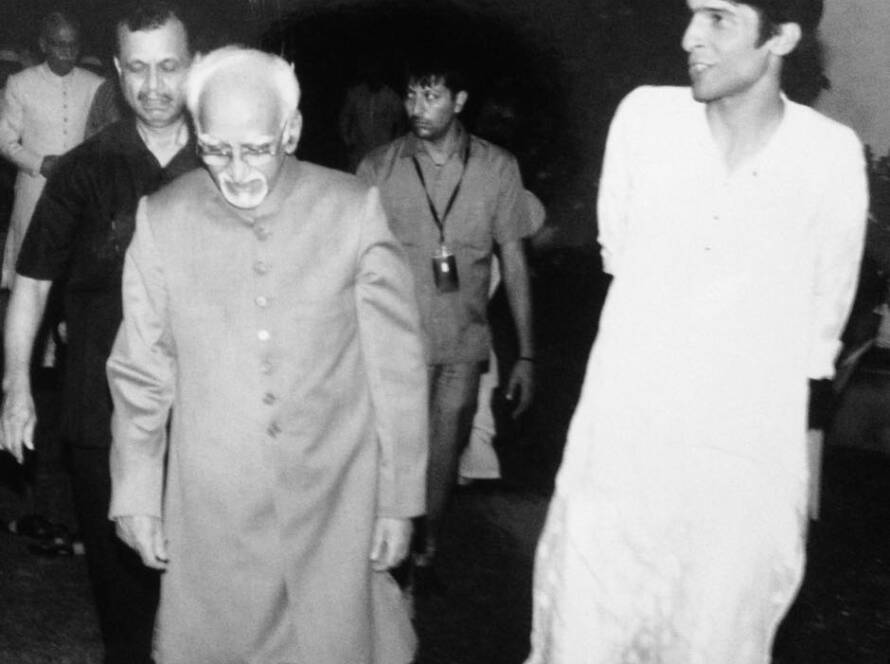
Some of my earliest observations of this administrative culture emerged through my father’s interactions within the constitutional establishment during the presidency of the late Shri Pranab Mukherjee. During that period, my father served within circles connected to institutional evaluation processes associated with the selection architecture of the Union civil services, including participation in interview panels linked to recruitment assessment.
What remained striking was not the glamour often associated with elite administration, but the seriousness with which the idea of public service was treated by many within those circles.
One gradually understood that the Indian state reproduces itself not merely through examinations, but through institutional temperament.
Candidates were evaluated not only for intelligence, but for composure, judgment, discretion, administrative balance, and psychological steadiness under scrutiny.
The Republic, in effect, searches not merely for brilliance.
It searches for endurance.
That insight clarified something essential about the civil services:
administration is not only a profession.
It is a constitutional temperament.
VIII. THE LONELINESS OF THE CIVIL SERVANT
The public imagination frequently misunderstands power.
It imagines power as visibility.
In administration, power often exists in anonymity.
The most consequential decisions of the state are frequently prepared by individuals whose names the public never learns. They draft memoranda during crises, coordinate relief during disasters, negotiate procedural compromises during constitutional deadlock, and sustain institutional continuity while political attention shifts elsewhere.
History remembers prime ministers.
The administrative state remembers everyone else.
There is therefore a peculiar loneliness embedded within bureaucratic life. Success often remains invisible because administrative success appears merely as societal normalcy. Trains run. Revenue flows. Diplomacy continues. Crises are contained quietly before they become visible catastrophes.
When administration functions well, the public rarely notices it.
Yet when it fails, the state itself becomes exposed.
The civil servant thus inhabits an unusual moral position:
authority without celebrity,
responsibility without applause,
and permanence without recognition.
The Republic depends profoundly upon such individuals.
Not because they are flawless.
But because constitutional continuity requires people willing to serve institutions larger than themselves.
The Republic is not defended only at its borders or in its elections.
It is defended quietly each day inside offices where restraint still survives ambition.
Fides et Ordo | Trust & Order
— Aamir Khan Wali
The Chambers of Amir Khan Wali
The Armoury • The Despatch • Network Intelligence