
THE PRESIDENCY: POWER WITHOUT FORCE, LAW WITHOUT COMMAND
A Constitutional Meditation from the President’s House to the Fellowship of Law
- WHY BEGIN WITH THE PRESIDENT?
Constitutional scholarship, like constitutional law itself, tends toward the gravitational pull of visible power. Courts that pronounce final judgments, legislatures that enact binding commands, executives that deploy the coercive apparatus of the state—these are the familiar subjects of jurisprudential inquiry, the dramatis personae of our professional literature. They act, and their actions produce consequences measurable in liberty restrained, rights secured, and authority distributed. To study law is, in significant measure, to study the modalities of institutional action.
The Presidency of India resists this analytical inclination. It does not act, at least not in the sense that courts, legislatures, and political executives act. It adjudicates no disputes, frames no policies, commands no coercive machinery independent of the political executive whose advice binds it. The President signs legislation but does not shape it, rather receives foreign dignitaries but does not conduct foreign policy, proclaims emergencies but does not conceive them and appoints governments but does not govern. On a purely functional accounting, the office appears an constitutional ornament—dignified, ceremonial, but ultimately marginal to the serious business of democratic governance.
This appearance is not merely deceptive. It is deliberately cultivated. The Indian Presidency was designed not to act, and its refusal to act is not a constitutional limitation to be regretted but an institutional achievement to be understood. The office is a constitutional paradox: immense symbolic authority coupled with minimal autonomous power; the apex of the constitutional order yet subordinate to the political executive; the formal repository of vast emergency powers that cannot be exercised without ministerial advice and whose exercise is subject to judicial review. It is, in the felicitous phrase of constitutional theorist H.M. Seervai, an office of “dignity, not power”—but dignity, properly understood, is itself a form of constitutional power, albeit power of a radically different register than command, coercion, or control.
The Despatch begins with the Presidency because the office illuminates something essential about constitutional democracy that more active institutions cannot reveal. We learn about constitutional systems not only by observing how they exercise power but by examining how they restrain it. The Presidency is the constitutional conscience of the Indian republic—not because Presidents have been uniformly virtuous (though many have been), not because the office has never been strained or tested (it has, repeatedly), but because the office itself, in its structural DNA, encodes a profound constitutional insight: that legitimate governance requires not only effective authority but also its deliberate, institutionalised withholding.
This is not a claim about the personal qualities of individual office-holders. It is a claim about constitutional architecture. The Indian Presidency matters most when it appears weakest, because that apparent weakness is the measure of constitutional confidence. A Constitution that trusts itself can afford an executive head who does not rule. A democracy that has internalised the disciplines of parliamentary supremacy can vest formal authority in an office that exercises none of it autonomously. The Presidency is not a relic of monarchical sentiment preserved for ceremonial convenience, rather it is a sophisticated constitutional technology for reconciling the republican demand for elected leadership with the equally important demand that executive power be diffused, checked, and ultimately subordinated to the deliberative institutions of representative government.
This essay is therefore not a chronicle of presidencies, still less an evaluation of Presidents. It is an inquiry into constitutional self-discipline—into the institutional architecture that enables the Indian state to vest its highest constitutional office in a figure who governs by not governing, commands by not commanding, and acts by withholding action. The Presidency is the quiet place where the Constitution reminds itself that democracy is not merely about the capacity to act but about the wisdom to refrain; not merely about the concentration of authority sufficient to govern but about its distribution sufficient to secure liberty; not merely about the effectiveness of power but about its legitimacy.
- A SHORT GLOBAL HISTORY OF THE PRESIDENCY
The modern presidency is not an ancient institution, though it draws on ancient anxieties. The Roman Republic distributed executive authority through consuls who held power jointly, briefly, and under the shadow of potential prosecution for misconduct in office. Even the dictatorship, that most concentrated of Roman executive institutions, was time-bound and constitutionally circumscribed—a temporary suspension of ordinary procedures in response to existential threat, not a permanent concentration of authority. Rome taught later constitutional designers a lesson it took centuries to fully absorb: executive power is necessary for governance but fatal to liberty unless hedged with limits, checks, and temporal boundaries.
The American presidency emerged from this inherited anxiety, though its framers chose a different path than Rome’s collegiate executive. The Constitution of 1787 rejected monarchy explicitly while preserving unitary executive authority—a decision that reflected not confidence in executive power but a pragmatic judgment that dispersed executive authority would prove unworkable and that an elected, term-limited, impeachable president was preferable to the uncertainty of congressional governance. The American president was powerful but never absolute; commander-in-chief but subject to congressional declaration of war; chief executive but constrained by congressional appropriation; head of state but removable by legislative impeachment and trial. The genius of the American constitutional design was not the strength it conferred upon the presidency but the multiplicity of constraints it imposed upon its exercise.
France experimented more restlessly with executive design. The Third and Fourth Republics reduced the presidency to near-ceremonial insignificance, vesting effective authority in a parliament whose fragmentation produced chronic instability. The Fifth Republic reversed this trajectory, constructing a presidency of formidable constitutional authority designed to overcome the immobilism of assembly governance. Yet even the French presidency, for all its power, operates within a semi-presidential framework that divides executive authority between president and prime minister, producing alternating dynamics of dominance and cohabitation that constrain any single actor’s capacity for unilateral command.
Latin American presidentialism, transplanted from American constitutional soil into contexts of weaker institutional development, revealed the pathologies that emerge when presidential symbolism is unaccompanied by presidential restraint. The history of Latin American presidencies is, with notable exceptions, a history of the fusion of symbolic authority with substantive power—a fusion that produced, across multiple jurisdictions and generations, the characteristic figure of the caudillo, the executive who embodies the state so completely that constitutional limits become parchment barriers rather than operative constraints.
Across these diverse constitutional experiments, a common tension persists: the tension between symbolism and command, between the presidency as representative institution and the presidency as governing institution. Every constitutional democracy must locate its presidency somewhere along this spectrum, and that location reveals fundamental choices about how power is imagined, distributed, and constrained. India’s location was unambiguous and deliberately chosen. It adopted the most legally constrained model of presidency available in the comparative constitutional repertoire—a ceremonial presidency on the German and Italian model, not an executive presidency on the American or Brazilian model, not a hybrid presidency on the French model, and emphatically not an authoritarian presidency on any model. This was not derivative constitutional borrowing but deliberate constitutional choice, animated by a clear-eyed assessment of the risks of executive dominance and a principled commitment to parliamentary supremacy as the organising logic of Indian democracy.
III. THE INDIAN PRESIDENCY: HISTORICAL EVOLUTION
The Constituent Assembly that framed India’s Constitution did not debate the Presidency as an abstract exercise in comparative institutional design. It debated the Presidency as a response to lived experience—specifically, to the experience of colonial governance under a Governor-General who combined ceremonial authority as the Crown’s representative with substantive authority as the effective head of the colonial administration. The Government of India Act 1935 had vested enormous discretionary powers in the Governor-General, including powers to act independently of ministerial advice in significant domains of governance. This was not an oversight; it was the constitutional architecture of empire, designed to preserve ultimate imperial control behind the facade of responsible government.
The framers of India’s Constitution were determined not to reproduce this architecture. They understood that vesting discretionary authority in a constitutional head of state, however benign its initial exercise, creates institutional space for the concentration of power that democratic governance requires remain diffuse. Dr. B.R. Ambedkar, whose constitutional vision permeates the final text, was characteristically unequivocal on this point. The President, he insisted during the Assembly debates, must be the constitutional head of a parliamentary system, not the executive head of a presidential system. There could be no middle ground, no space for discretionary authority, no residual executive power independent of ministerial advice. The Governor-General model was rejected not merely as inappropriate for independent India but as fundamentally incompatible with the very idea of responsible government.
This was not a minor skirmish over institutional design. It was a foundational constitutional commitment, debated with the gravity it deserved and resolved with the clarity the occasion demanded. The Indian President would possess the formal trappings of executive authority—Article 53 vests the executive power of the Union in the President—but would exercise that power only on the aid and advice of the Council of Ministers. The form of executive vesting would be unitary and presidential; the substance of executive governance would be collective and parliamentary. This disjuncture between constitutional form and constitutional substance was not an embarrassment to be concealed but a design feature to be celebrated—a deliberate separation of the symbolic authority to represent the state from the operational authority to govern it.
The subsequent history of the Indian Presidency is best understood not as a succession of individual tenures but as a series of constitutional moments in which the relationship between presidential form and parliamentary substance was tested, clarified, and reinforced. The foundational presidency of Rajendra Prasad witnessed the first such test, when Prasad sought to assert a more expansive conception of presidential discretion than the constitutional text, read in light of the Assembly debates, appeared to authorize. Prime Minister Nehru’s firm resistance to this assertion, grounded in a meticulous reading of constitutional text and an unyielding commitment to parliamentary supremacy, established a precedent that has governed the office ever since—not through formal amendment but through the accumulation of constitutional practice that carries the binding force of convention.
The Emergency years of 1975-1977 represented the most severe constitutional strain on the presidential office, though the strain was borne silently and without public articulation. The President during this period, Fakhruddin Ali Ahmed, acted upon the advice of the Prime Minister in proclaiming the Emergency under Article 352, and the constitutional question of whether he possessed any residual discretion to decline such advice remains debated among constitutional scholars. What is not debated is that the Emergency revealed, in starkest form, both the potential vulnerability of a constitutionally constrained presidency to executive dominance and the ultimate resilience of constitutional forms that outlast their temporary subordination.
The presidency of K.R. Narayanan marked a different kind of constitutional moment—not the assertion of executive authority against parliamentary supremacy but the articulation of constitutional conscience within the limits of parliamentary government. Narayanan returned presidential questions to the government of the day, sought clarification on matters of constitutional significance, and on one notable occasion returned a matter for reconsideration under Article 111. He did not purport to veto, to override, or to substitute his judgment for that of the political executive. He asked questions, expressed doubts, and sought explanation—actions entirely within the constitutional competence of the President and entirely consistent with the design of the office as a constitutional safety valve rather than an independent centre of power.
Later presidencies have operated within this settled constitutional understanding. The office has not expanded its formal powers, nor have successive Presidents sought to do so. The constitutional settlement achieved in the early decades of the Republic has proven remarkably durable, not because it has never been tested but because each test has reaffirmed, rather than revised, the fundamental distinction between presidential form and parliamentary substance that lies at the heart of Indian constitutional design.
- THE CONSTITUTIONAL POSITION OF THE PRESIDENT OF INDIA
The constitutional position of the Indian President is defined by a cluster of provisions whose surface simplicity conceals considerable interpretive depth. Articles 52 to 62 establish the office, its mode of election, its qualifications, its oath, its term of office, and the procedure for its impeachment. These provisions are largely non-controversial, establishing the institutional framework within which presidential authority operates.
The operational heart of the presidency lies elsewhere. Article 74 provides that there shall be a Council of Ministers with the Prime Minister at its head to aid and advise the President in the exercise of his functions. The original text of Article 74(1) concluded with a proviso that the President might “require the Council of Ministers to reconsider such advice, either generally or otherwise,” but did not specify the consequences of such reconsideration. This ambiguity, whether deliberate or inadvertent, created interpretive space for claims of residual presidential discretion that the subsequent constitutional history would firmly close.
The Forty-Second Amendment Act of 1976 amended Article 74(1) to declare that the President “shall, in the exercise of his functions, act in accordance with such advice.” The amendment eliminated the textual ambiguity that had permitted alternative readings, substituting a clear constitutional command. The Forty-Fourth Amendment Act of 1978 restored the proviso permitting presidential reconsideration while explicitly declaring that the President “shall act in accordance with the advice tendered after such reconsideration.” The constitutional position is now unequivocal: the President is bound by ministerial advice, may seek reconsideration once, but must ultimately act upon the advice tendered.
Article 75, which establishes the collective responsibility of the Council of Ministers to the House of the People, reinforces this structure of subordination. The President appoints the Prime Minister and, on the Prime Minister’s advice, other ministers; but the effective choice of Prime Minister is determined by the confidence of the parliamentary majority, and ministerial tenure is dependent upon that confidence rather than presidential pleasure. Here again, constitutional form vests authority in the President while constitutional substance vests it in the parliamentary system.
Articles 111 and 123 address the President’s role in the legislative process. Article 111 permits the President to return a bill for reconsideration, but imposes no power of veto in the American sense; if the bill is passed again, with or without amendment, the President “shall not withhold assent therefrom.” Article 123 empowers the President to promulgate ordinances when Parliament is not in session, but only if satisfied that circumstances exist rendering immediate action necessary. Both provisions have been construed narrowly, consistent with the overall architecture of presidential subordination to parliamentary authority.
Articles 352, 356, and 360 confer upon the President emergency powers of immense constitutional gravity—the power to proclaim a national emergency, to assume state executive functions, and to proclaim a financial emergency. Yet here again, constitutional form and constitutional substance diverate. The President’s satisfaction under these provisions is, by settled judicial interpretation, the satisfaction of the Council of Ministers; the emergency powers are exercisable only on ministerial advice; and the exercise of these powers is subject to judicial review on grounds of constitutional validity.
The Indian President is thus a constitutional paradox embodied in constitutional text: the formal repository of vast powers that cannot be exercised autonomously; the constitutional head of a parliamentary system in which effective authority vests in the political executive; the ceremonial representative of the state whose representative function is itself a form of constitutional power, though power of a radically different register than command, coercion, or control. The President acts through doubt, not direction; through questions, not commands; through the withholding of action, not its assertion. This is not a constitutional limitation to be regretted. It is a constitutional achievement to be understood.
- PRESIDENTIAL IMMUNITY AND ACCOUNTABILITY
Article 361 of the Constitution addresses the relationship between the President and the ordinary processes of civil and criminal law. Its provisions are striking: the President shall not be answerable to any court for the exercise of the powers and duties of office; no criminal proceedings whatsoever shall be instituted or continued against the President during term; no civil proceedings in which relief is claimed against the President shall be instituted until two months’ notice in writing has been delivered.
These immunities have attracted considerable commentary, some of it critical. Yet the constitutional design is more nuanced than superficial readings suggest. Article 361 confers immunity, not impunity; the immunity is procedural, not substantive; it operates during term, not indefinitely; it protects the office, not the person.
The distinction between procedural immunity and substantive impunity is fundamental. A President cannot be prosecuted while in office, but can be prosecuted thereafter. Civil proceedings are not barred but conditioned upon notice, a requirement designed to protect presidential time and attention from vexatious litigation rather than to shield presidential conduct from judicial scrutiny. The President is not above the law; the President is, during tenure, deferred from the law’s immediate application.
This constitutional balance reflects sophisticated institutional judgment. The dignity of the highest constitutional office requires insulation from distraction, harassment, and the destabilising effects of litigation. But the constitutional commitment to the rule of law requires that no person, whatever their office, enjoy permanent exemption from legal accountability. Article 61 addresses the most extreme case through impeachment for violation of the Constitution. Article 361 addresses the ordinary case through temporal deferral rather than substantive exemption.
Post-tenure accountability completes this constitutional architecture. A former President may be sued in civil proceedings, prosecuted for criminal conduct, and held to account for actions taken prior to, during, or after office. The immunity conferred by Article 361 is an immunity of office, not of person; when the office is vacated, the immunity expires. This is not an evasion of accountability but its deliberate postponement, calibrated to balance the competing demands of institutional dignity and legal order.
- JUDICIAL ENGAGEMENT WITH THE PRESIDENCY
The Supreme Court of India has addressed the constitutional position of the Presidency in a series of decisions that collectively construct a coherent jurisprudence of institutional restraint. These cases do not, with rare exceptions, present the Presidency as a litigant asserting its own interests. They present, instead, actions taken in the President’s name whose constitutional validity is challenged before the courts. The President is not a party to these proceedings in any meaningful sense; the Union of India, represented by the political executive, defends the constitutional validity of the challenged action.
Shamsher Singh v. State of Punjab, decided by a seven-judge bench in 1974, remains the foundational authority on the constitutional position of the President. The Court held, with unequivocal clarity, that the President is a constitutional formal head, exercising powers vested in him only on the aid and advice of the Council of Ministers. No discretion, no independent authority, no residual executive power survives this constitutional structure. The President is the constitutional head of a parliamentary system, not the executive head of a presidential system. Shamsher Singh did not create this constitutional architecture; it recognised and declared what the Constitution had always required.
The Bommai line of cases, arising from the dismissal of state governments under Article 356, addressed the justiciability of presidential satisfaction. The Court held that the President’s satisfaction, though formally required for the exercise of this power, is the satisfaction of the Council of Ministers and is subject to judicial review. The Court does not inquire into presidential motives, for motives are constitutionally irrelevant; but the Court examines the material upon which the satisfaction was based, the relevance of that material to the constitutional standard, and the rationality of the conclusion drawn. This is not judicial supervision of the President but judicial enforcement of constitutional limits upon executive action.
Rameshwar Prasad v. Union of India applied these principles to hold that the proclamation under Article 356 must be based on material relevant to the constitutional standard and that the satisfaction, however formally perfect, is vitiated if the underlying material is legally insufficient. The Court did not purport to judge the President; it judged the constitutional validity of advice tendered to the President and acted upon in the President’s name. The distinction is critical to understanding both the nature of presidential power and the character of judicial review.
Ram Jawaya Kapur v. State of Punjab, decided in the early years of the Republic, established the fundamental principle that executive power, though formally vested in the President by Article 53, is in substance exercised by the political executive accountable to Parliament. This decision, predating the constitutional amendments that would clarify the binding nature of ministerial advice, anticipated the interpretive trajectory that subsequent decades would confirm.
The consistent thread running through this jurisprudence is the Court’s refusal to personalise constitutional review. The Court does not inquire into what the President thought, intended, or desired; these are constitutionally irrelevant and judicially inaccessible. The Court inquires into what advice was tendered, what material supported that advice, and whether the action taken is within constitutional limits. The President’s name appears in the case title; the President’s constitutional position is the subject of judicial elaboration; but the President as an individual, with personal views and preferences, remains outside the frame of judicial inquiry. This is constitutional accountability without personalisation—a jurisprudence of institutions, not individuals.
VII. HEADS OF STATE IN INTERNATIONAL LAW
The position of heads of state under international law has undergone significant evolution, reflecting both the persistence of traditional immunities and their progressive erosion in response to the demands of international criminal accountability. The classical framework distinguished between personal immunity, which protects the serving head of state from foreign criminal jurisdiction absolutely, and functional immunity, which protects official acts even after the individual has left office.
Personal immunity, or immunity ratione personae, attaches to the office rather than the individual and endures only as long as the office is held. Its rationale is functional: international intercourse requires that heads of state be able to travel, negotiate, and represent their states without fear of harassment or detention by foreign judicial authorities. The immunity is absolute during tenure, covering both official and private acts, but expires when the office is vacated. A former head of state enjoys no personal immunity for acts committed prior to, during, or after office.
Functional immunity, or immunity ratione materiae, attaches to official acts rather than the office itself and endures beyond tenure. Its rationale is that acts performed in official capacity are attributable to the state rather than the individual and thus enjoy the same immunity from foreign jurisdiction that the state itself enjoys. This immunity is not absolute; it does not extend to international crimes, which are not recognised as legitimate official acts under international law.
The erosion of absolute head-of-state immunity is associated, in the jurisprudence of multiple jurisdictions, with the Pinochet litigation in the United Kingdom. The House of Lords held that former Chilean head of state Augusto Pinochet enjoyed no immunity from extradition proceedings alleging torture, on the ground that torture was an international crime for which functional immunity could not attach. This decision, controversial in its reasoning and contested in its implications, marked a decisive shift in the international law of official immunity.
Subsequent jurisprudence of the International Criminal Court and the ad hoc international criminal tribunals has reinforced this trajectory. The Rome Statute of the International Criminal Court provides that official capacity as head of state shall not exempt a person from criminal responsibility and shall not constitute a ground for reduction of sentence. The statute’s drafting history reveals deliberate rejection of head-of-state immunity as a barrier to international criminal prosecution.
India’s position within this evolving international framework is principled and restrained. We respect the sovereignty of states and the dignity of their constitutional representatives. We acknowledge the immunities conferred by international law upon serving heads of state. We do not recognise any absolute shield against accountability for international crimes of grave concern. The Constitution that confers immunity also embodies the values that limit it—values of human dignity, rule of law, and accountability that transcend national boundaries and inform the developing international legal order.
VIII. THE PRESIDENT’S ESTATE AS CONSTITUTIONAL CLASSROOM
There are institutions one understands through study, through the patient accumulation of doctrinal knowledge and the disciplined analysis of constitutional text. There are other institutions one understands through absorption—through the osmosis of atmosphere, the sedimentation of impression, the slow accretion of lived experience that deposits constitutional understanding in layers beneath conscious reflection. Rashtrapati Bhavan belongs to this second category.
I was six, perhaps seven, when I first encountered the Office of the Excellent President of India, though I possessed neither the vocabulary nor the conceptual framework to recognise it as such. We were attending a birthday celebration for Tara, granddaughter of President R. Venkataraman, at his retirement residence in Delhi. There were balloons, khoey bags, return gifts distributed to children, an artist moving among us with charcoal and paper, capturing young faces in swift, sure strokes. The afternoon was gentle, sunlit, unremarkable except in the quality of order that pervaded it—an order so effortless, so unperformed, that it registered only as atmosphere rather than architecture.
I did not understand then that I was observing the institutional ethos of the Indian Presidency. I understood only that the most powerful man in India, or the man who had until recently held that office, had made room for a child’s birthday party, and that this act of making room was itself a form of power—not the power to command, but the power to yield and not the power to dominate, but the power to accommodate. The lesson was deposited without instruction, absorbed without examination, available for retrieval decades later when constitutional study would supply the vocabulary I had lacked at six.
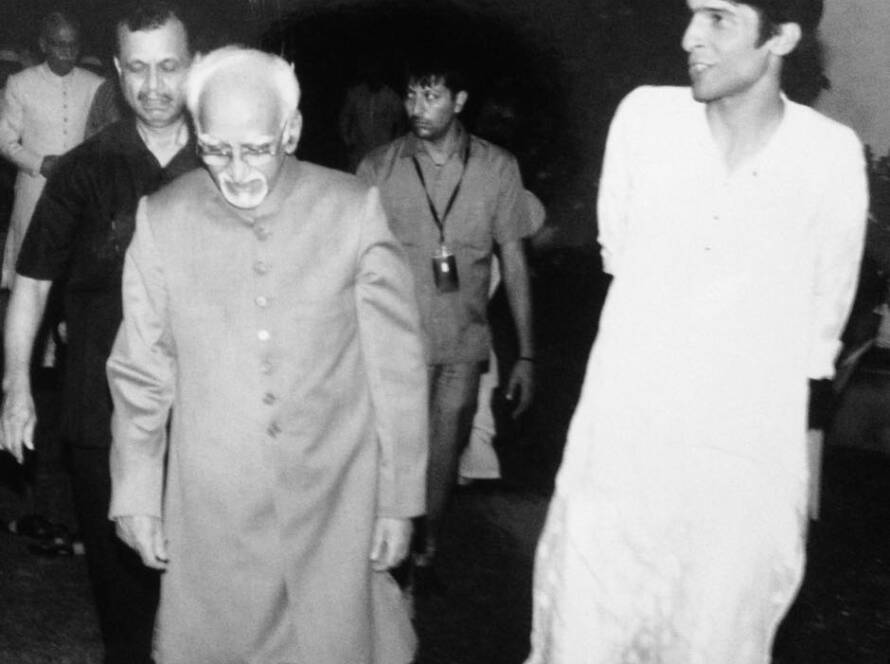
Later, during the presidency of Dr. Shankar Dayal Sharma, we resided at 6, President’s Estate situated on Talkatora Road. Evenings acquired ritual form: my father, the President’s honorary physician, would conduct his nightly visit to Rashtrapati Bhavan, and I, too young to remain unattended, accompanied him. The corridors of the President’s Secretariat became, in the course of these evening excursions, a constitutional classroom without desks, blackboards, or examinations. I wandered while my father worked, exploring rooms whose functions I did not understand, observing process without comprehending its constitutional significance.
I remember, with the vivid particularity that attaches to childhood wonder, a pair of shoes manufactured by a company called Action, whose soles flickered red with each step. The technology was primitive by contemporary standards, but to a child traversing the silent corridors of Rashtrapati Bhavan, those intermittent red pulses conferred nothing less than superpowers. I walked with exaggerated gait, planting each foot with deliberate emphasis, leaving behind ephemeral constellations that faded almost as quickly as they appeared. The corridors accepted this innocent profanation of their dignity with the patient tolerance that is the institutional virtue of settled authority.
President Sharma and his wife, Vimla ma’am, would receive us in their drawing room—not formally, not ceremonially, but with the quiet hospitality of those for whom the distinction between public office and private self has become, through long discipline, nearly seamless. My father would conduct his examination, the ritual of stethoscope and blood pressure cuff that is the grammar of medical care, while the President sat in patient stillness. I observed, from the periphery of these encounters, that authority could be exercised through submission—that the President, by submitting to the ordinary procedures of medical examination, demonstrated a form of constitutional authority more profound than any assertion of will could achieve.
One evening, the President gestured toward me with the slow deliberation of a man who measured his movements as carefully as his words. I approached, hesitant, my luminous shoes now silent beneath the weight of unexpected attention. He lifted me onto his lap—I was small for my age, and light—and regarded me with patient inquiry. What will you be, he asked, when you grow up?
I did not know. I was too young to have formed ambition into articulation, too shy to speak the unformed dreams I could not yet name. I sat in the lap of the President of India and offered him silence in response. He did not press. He did not insist. He received my silence as sufficient and continued to hold me in the warm gravity of his attention. I was learning, though I did not know it then, that constitutional authority includes the authority to wait, to accommodate, to accept silence as response.
Our designated chauffeur, Madan, a man of steady disposition and inexhaustible patience, would in his free hours guide me through the precincts of the 330-acre estate. I pursued peacocks through the Mughal Gardens with the single-minded determination that only children can muster, attempting capture with strategies that ranged from stealthy approach to enthusiastic chase. I never succeeded. The peacocks, possessed of that dignified aloofness characteristic of beautiful creatures, maintained always the precise distance required to remain beyond reach. I did not understand, then, that I was encountering the constitutional ethos of the Presidency in avian form: power expressed through withdrawal, authority manifested in the maintenance of dignified distance.
These experiences deposited constitutional understanding that formal legal education would later organise and articulate. I learned that process is power, though power of a different register than command. I learned that silence is not absence but presence held in reserve. I learned that the state is continuity, not personality—that the corridors of Rashtrapati Bhavan have witnessed many Presidents and will witness many more, that the building accommodates individual tenures without being defined by any of them. I learned that respect for procedure is not bureaucratic pedantry but democratic discipline, the institutional encoding of the principle that no person, however exalted, stands above the forms that constrain the exercise of public authority.
- MATURITY AND THE LATER PRESIDENCY
The years between presidential tenures brought distance, reflection, and the slow accretion of professional identity. I had grown from the boy who chased peacocks through the Mughal Gardens into a young man pursuing law with the same focused determination I had once devoted to the capture of iridescent birds. I was reading the Constitution with the vocabulary I had lacked at eight, recognising in its provisions the institutional ethos I had absorbed without articulation. I was practising law in the courts of Delhi, Bombay, Madaras and learning the grammar of pleadings and the syntax of cross-examination, discovering that the discipline of legal argument is, at its core, a discipline of constitutional interpretation.
I was also, in the way of young men, discovering the education that occurs beyond institutional walls. A Russian scholar, whose name I withhold out of respect for the privacy that protects friendship from the biographer’s appropriation, had come to India to study Hindi, Sanskrit, and Urdu. She was tracing the migration of concepts across linguistic borders, discovering in the relationship between Sanskrit and Urdu a model for civilisational dialogue that transcended the political ruptures of more recent memory. Through her, I encountered my own country’s linguistic heritage as something to be studied rather than merely inhabited. We explored the western Ghats for a period 3-4 months and I learned that constitutional pluralism has deeper roots than the Constituent Assembly debates—that the Constitution’s commitment to linguistic diversity and cultural accommodation reflects civilisational inheritances that predate the modern state and will survive its transformations.
It was during this period that I came to fully know His Excellency Hon’ble President Pranab Mukherjee not as the distant figure of constitutional office but as a statesman of formidable intellect and disciplined constitutional vision. I worked on one matter outstanding to the Dabhol Power Project in my early years. His reputation preceded him, of course. He had served Indira Gandhi with such unwavering fidelity that he was described, with a mixture of admiration and reduction, as her “man for all seasons.” The phrase, borrowed from Thomas More’s description of himself, carried theological weight: a man for all seasons is a man whose principles are not contingent upon the prevailing climate, whose commitments survive the transition from summer to winter, from favour to disfavour, from power to opposition.
I found this characterisation both accurate and incomplete. President Mukherjee was indeed loyal—to Indira Gandhi, to the Congress party, to the constitutional order he had spent a lifetime interpreting and serving. But his loyalty was not the loyalty of a courtier seeking favour or a bureaucrat seeking advancement. It was the loyalty of a constitutionalist who understands that institutions are sustained not by episodic heroism but by steady, undramatic fidelity; that constitutional governance requires not the occasional dramatic assertion of principle but the patient, unglamorous work of making institutions function.
When I had the opportunity to share my reflections on India’s constitutional tradition with him—on the relationship between its formal provisions and its civilisational inheritance, on the challenges facing its legal institutions and the resources within its traditions for addressing them—he listened with the focused attention I had observed, decades earlier, in the drawing rooms of his predecessors. He did not interrupt. He did not correct. He did not perform the gestures of listening while awaiting opportunity to speak. He listened as a statesman listens: not to formulate response but to comprehend perspective, not to defeat argument but to understand conviction.
President Mukherjee attended my sister Sana’s wedding. This is not, in the ordinary course of constitutional analysis, a fact of doctrinal significance. Yet it illuminates something about the Indian Presidency that constitutional text alone cannot capture. He came not as the President performing a ceremonial duty but as Pranab Mukherjee, a man who had known my father through decades of professional trust and personal regard. He signed the nikahnama—the Islamic marriage contract that formalises, in the presence of witnesses and the grace of God, the union of two souls and two families. Beside his signature, the then Chief Justice of India inscribed his own. A Muslim President, a Chief Justice, a wedding in Delhi that too inside the Rashtrapti Bhavan, and the Constitution of India watching over all of it.
There was no spectacle in this. No assertion of symbolism, no performance of secularism, no declaration of communal harmony. There was only the quiet convergence of institutions and individuals, offices and persons, constitutional forms and human relationships. The President signed his name. The Chief Justice signed his name. The marriage was solemnised. Life continued. This is how constitutional institutions should intersect with personal existence—not as grand pronouncements but as quiet presence; not as assertion of authority but as acceptance of invitation; not as performance of constitutional virtue but as the unremarkable normalcy of citizens discharging ordinary obligations.
- THE MODERN PRESIDENCY: STRAIN AND RELEVANCE
The Indian Presidency confronts conditions its framers could not have anticipated. The twenty-four-hour news cycle demands comment on every political development, analysis of every policy initiative, judgment on every constitutional controversy. Social media platforms reward immediacy over reflection, outrage over deliberation, assertion over inquiry. This is also captured in the opening volume of my debutant four part series, literary work titled as Beyond Headlines: A case for Specialised Media Tribunal. The President, who must be above politics, is constantly invited to enter politics—to take sides, to declare preferences, to intervene in the very domain from which the Constitution so carefully excludes her.
The pressure to speak is intense and unrelenting. Silence, in an age of constant communication, is misread as absence. Restraint is misinterpreted as irrelevance. The President who declines to comment on political controversies is deemed passive, marginal, inconsequential. Yet the constitutional value of the Presidency lies precisely in its refusal to perform the role that contemporary media culture assigns it. The President who speaks rarely speaks with constitutional authority; the President who intervenes selectively intervenes with constitutional gravity; the President who withholds comment withholds the moral authority of the office from the partisan fray.
The ordinance power, originally conceived as a limited exception to the normal legislative process, has expanded in practice to a degree that strains constitutional design. Presidents promulgate ordinances on ministerial advice, as the Constitution requires; but the frequency and scope of ordinance-making reflect deeper pathologies in the legislative process that no constitutional provision can remedy. The President authenticates; the President does not decide. Yet the authentication of executive legislation, however constitutionally regular, implicates the President in the displacement of parliamentary deliberation that the ordinance power, properly constrained, should never effect.
The Governor-President axis presents similar constitutional strains. Governors, appointed by the President on ministerial advice, exercise state-level functions that occasionally implicate the President’s constitutional responsibilities. Recommendations for President’s Rule under Article 356 originate with Governors, are transmitted through the Union government, and are acted upon by the President on ministerial advice. The constitutional form is meticulously observed; the constitutional substance, in moments of political polarisation, strains against the limits the framers imposed.
Yet for all these strains, the Presidency remains one of the few genuinely neutral spaces in Indian public life. When Parliament polarises along partisan lines, when courts are overburdened with litigation that defies timely resolution, when the political executive is consumed by the urgent demands of governance, the Presidency endures as an institution whose authority does not depend on alignment with any partisan project. This is not because Presidents have been uniformly non-partisan—many were prominent political figures before assuming office—but because the office itself, by constitutional design and accumulated convention, resists partisan capture. The President who leaves politics to assume the Presidency must, in a very real sense, leave politics behind.
This institutional neutrality is a constitutional achievement of immense significance, though it is rarely recognised as such. In a democracy as vast and various as India, where political competition is intense and partisan division deep, the existence of a constitutional office that stands above the fray, that represents the entire nation rather than any faction within it, that embodies the continuity of the republican idea across the ruptures of electoral succession—this is not ceremonial ornamentation but constitutional infrastructure, as essential to democratic functioning as the franchise itself.
- CONCLUSION: THE OFFICE THAT HOLDS, NOT RULES
The Indian President embodies constitutional faith, not constitutional authority. The distinction is fundamental and insufficiently appreciated. Authority commands; faith persuades. Authority compels; faith attracts. Authority governs through the coercive apparatus of the state; faith governs through the voluntary allegiance of citizens who recognise in the institution something that transcends the particular person who temporarily occupies it.
This is not a minor distinction. It is the central insight of the Indian constitutional design for the Presidency, the principle that animates every provision governing the office and every convention that has accreted around it. The President does not rule because the Constitution does not trust any single individual, however wise or virtuous, with the power to rule. The Constitution trusts institutions, processes, and the disciplined restraint that is the highest form of constitutional fidelity.
Democracy survives not only through power exercised but through power withheld. The Indian Presidency is the institutional embodiment of this proposition—the constitutional office that demonstrates, through its daily operations, that legitimate governance requires not only the capacity to act but the wisdom to refrain, not only the concentration of authority sufficient to govern but its diffusion sufficient to secure liberty, not only the effectiveness of power but its legitimacy.
This is why The Despatch begins with the Presidency. The courts, the tribunals, the media, the emergency powers, the countless other institutions and doctrines that will occupy these pages in future essays—all presuppose something that the Presidency teaches with particular clarity. Constitutional democracy is not merely a system for aggregating preferences and exercising power. It is a system for restraining power, diffusing authority, and cultivating the institutional habits that make liberty possible across generations.
Fides et Ordo. Trust and Order. The motto of The Armoury, the fellowship of legal practitioners to which I have dedicated my professional life, is also a constitutional ethic. Trust in institutions that have earned it through disciplined restraint and order that is maintained not through coercion but through the voluntary compliance of citizens who recognise in constitutional forms the architecture of their collective liberty. The Presidency exemplifies this ethic. The Armoury seeks to extend it, from the domain of constitutional governance to the domain of professional practice.
The corridors of Rashtrapati Bhavan are silent now, as they have always been silent, as they will remain silent through the presidencies to come. The shoes that flickered red with each step are long discarded, the peacocks have continued their dignified evasion of childish pursuit, the Presidents whose service I witnessed have passed from office into history, and from history into the constitutional memory that sustains the republican idea across the generations. But the institution endures, and the constitutional wisdom it embodies endures with it: that power exercised is less remarkable than power withheld, that authority asserted is less legitimate than authority restrained, that the office that holds without ruling serves the Constitution more faithfully than any ruler could.
This is the constitutional inheritance of the Indian republic, encoded in silent corridors and quiet drawing rooms, in patient Presidents who asked questions and accepted silence, in luminous shoes and elusive peacocks and the steady, undramatic fidelity of those who serve constitutional offices without seeking to dominate them. This is the constitutional education I received in the President’s House, though I did not recognise it as education and the Presidents did not recognise themselves as teachers. This is the constitutional wisdom The Despatch seeks to transmit, and The Armoury to enact, and Network Intelligence to disseminate—not as doctrine to be imposed but as insight to be shared, not as authority to be asserted but as faith to be cultivated.
The question President Sharma asked, in his drawing room decades ago, remains unanswered. What will you be when you grow up? I did not know then. I am still growing, still becoming, still discovering that constitutional fidelity is not a destination but a practice, not an achievement but a discipline, not a state of being but a mode of attending to the institutions that make collective liberty possible. Perhaps the answer is not a single destination but an orientation: to be one who serves institutions rather than dominating them, who withholds power rather than asserting it, who holds the constitutional order in trust rather than claiming ownership over it.
This is what I wish I had told President Sharma, though I was too young and too shy to articulate it then. This is what I tell myself now, in the quiet hours between court appearances and client consultations, when the weight of professional responsibility settles upon shoulders that once carried nothing heavier than luminous shoes. This is what I offer to the readers of The Despatch, to the members of The Armoury, to the young lawyers and aspiring constitutionalists who will, in their turn, wander the corridors of institutions not yet built and ask themselves what they will become.
The Presidency teaches that the highest authority is the authority that refrains from exercising itself. The Constitution teaches that the most legitimate power is the power that submits to form. The Republic teaches that the deepest fidelity is the fidelity that manifests as restraint rather than assertion. These are the lessons of the President’s House, and they are the lessons The Despatch exists to transmit—not as dogma but as discipline, not as doctrine but as orientation, not as conclusion but as beginning.
Fides et Ordo.
This essay inaugurates The Despatch’s series on constitutional institutions. Future contributions will examine the courts, the tribunals, the media, the emergency powers, and the countless other institutions and doctrines through which the Indian Constitution seeks to reconcile the demands of effective governance with the imperatives of ordered liberty. The Presidency, with which we begin, is not the most powerful of these institutions. It is, perhaps, the most instructive.
— Amir Khan Wali
The Chambers of Amir Khan Wali
The Armoury • The Despatch • Network Intelligence